I am convinced cognition and conservation need each other. As a researcher in animal cognition, I think it is fundamental to combine controlled studies in the lab with field research if we really want to understand the selection pressures that shape cognitive processes and maintain cognitive variation. At the same time, I see a huge and untapped potential for ethology to support effective conservation actions such as reintroductions, management, mitigation measures. Considering not only species’ ecology, but cognitive processes and individual variation will help achieve cost-effective and successful measures in contrasting the current mass extinction.
For these reasons, I am working on several fronts that include:
- Individual-based approaches to study global change.
- Implications of individual variation for conservation success under the current biodiversity crisis. The hope is to show that leveraging animal individuality will improve conservation actions. For example, we are currently investigating how individual differences in behaviour and cognition may affect the perception of environmental complexity in captivity pre-release, as well as post-release success addressing responses to novelty, and exploration of complex environments in lobsters.
- The role of behavioural flexibility in coping with environmental novelty, including human-altered and non-native habitats.
- Effectiveness of protected areas in conserving biodiversity and effects of protection regimes on differen aspects of animal behaviour and cognition. Here I’m mostly addressing different behavioural and cognitive responses to human disturbance, but also whether humans are perceived as a threat by animals that are not directly persecuted.
- Understanding how humans consider wild animals and what influences their opinions and perceptions.
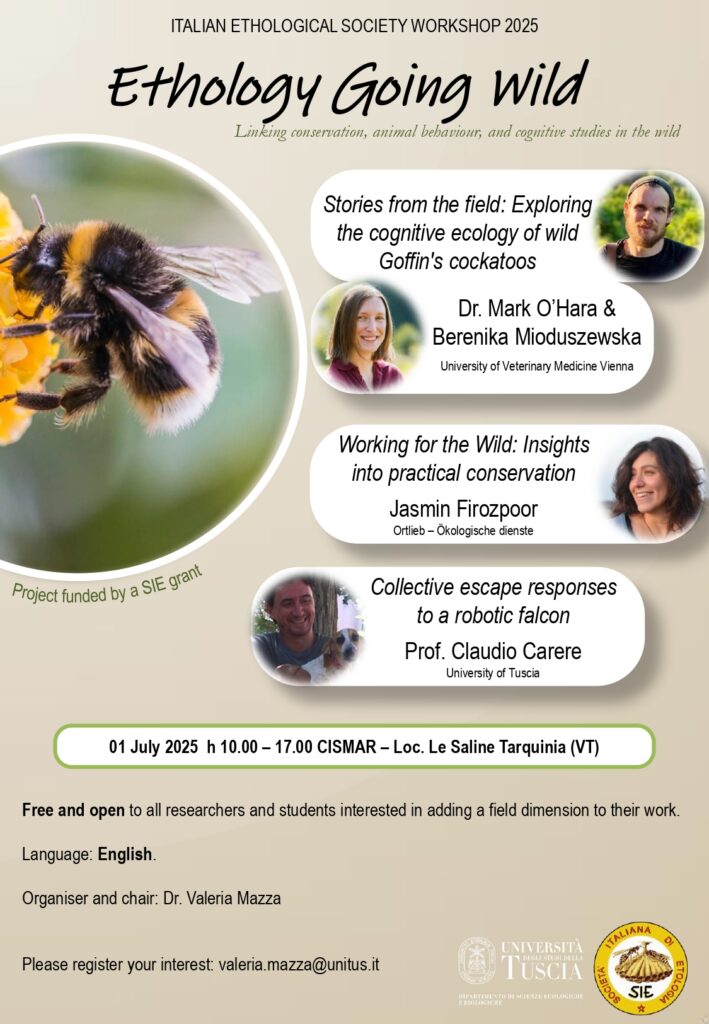
- Promoting dialogue between ethologists and conservation scientists and practitioners.
For the last one, I had the privilege of winning an award from the Italian Ethological Society and organise a workshop that brought together experts from different fields, and one year later we are still learnign and thinking (and writing!) together, in what promises to be an incredibly valuable exchange!
Main collaborators: J. Firozpoor (Ortlieb), Mioduszewska B., M. O’Hara, A. Sommese (VetMed UniVienna), V. Šlipogor (UniLausanne), Jeltsch F. (UniPotsdam), L. Saggiomo, B. Esattore, S. Gore (UniUmea), M. Másílková (UniPrague), P. Chow (UniChester), R. De Donno, G. Burini, F. Cerini, G. Polverino, A. Macali, C. Carere, D. Canestrelli, G. Chiatante (UniTuscia), E. Tricarico, Bianco M., Cavallo S. (UniFirenze)
Publications: Mazza & Šlipogor 2024 – Mazza & Carere 2024 – Cerini et al. 2025 – Jeltsch et al. 2025 – Mazza et al. 2026