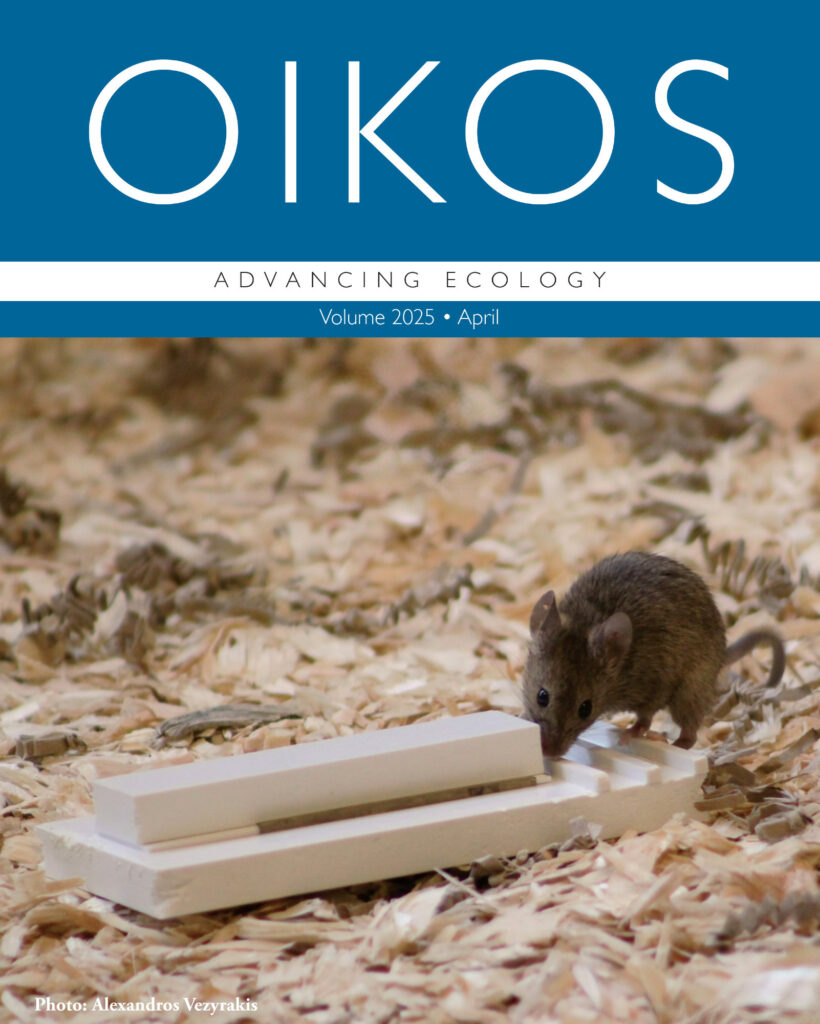
Innovation is the ability to produce new behaviours or to apply novel solutions to old problems, introducing novel variants into a population’s behavioural repertoire. However, not all individuals in a population are equally likely to solve novel problems, and it is unclear which individual characteristics make a successful innovator. Understanding the mechanisms behind these differences is essential for advancing our knowledge of animal cognition. Theory suggests a mixture of intrinsic and extrinsic characteristics shape the profile of an innovator, including age, sex, personality, and the type and stability of environmental conditions.
As innovation is shaped by multiple factors, it is paramount to understand its ontogeny, the barriers individuals face when encountering novel opportunities, and the evolutionary mechanisms that maintain individual differences in innovative behaviour.
In this project we investigated both proximate and ultimate factors that shape innovation, focusing on how innovation emerges, what behavioural and ecological constraints govern each individual’s propensity to innovate, and how differences in innovation could evolve.
We carried out a series of experiments in controlled conditions but especially in replicated populations of house mice (Mus musculus domesticus) living under semi-natural conditions. Basically, we reproduced the conditions of house mice colonies living in an attic – but in wonderfully hi-tech rooms in which we could monitor each individual and know where they were living, who they were living with, or whether they would explore together.
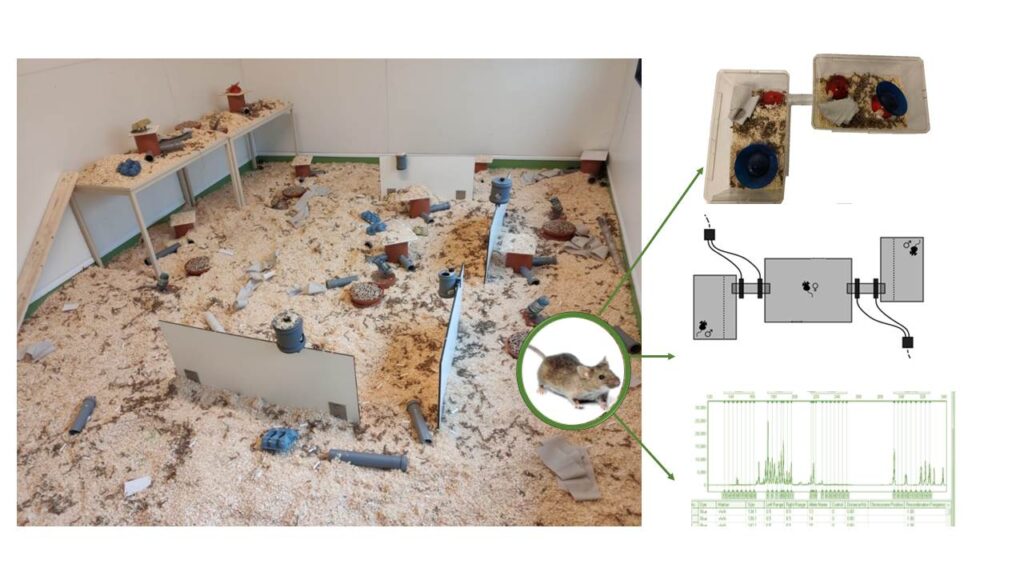
Contrasting most existing literature, we found no direct effects of personality on the likelihood to perform innovative problem-solving. However, there was an indirect effect, with shyer individuals visiting the puzzles to solve more often, which improved their likelihood of solving them. Additionally, mice performed significantly better when tested under controlled conditions with minimal distractions, compared to their performance under the noisy (literally and metaphorically), socially demanding semi-natural enclosures. Which means we really need to be careful when we want to transfer findings from a controlled lab to real world conditions. The silver lining, however, is that different conditions allow us to measure different aspects of problem-solving. Studying individuals in controlled conditions (e.g. in the laboratory, socially isolated) allows us to determine whether an individual can solve problems, but uncontrolled conditions (e.g. in the wild or in semi-natural enclosures) will tell us if it will.
We also had a look at how age and experience may influence how mice solve novel problems, and found that innovative behaviour emerges early in life. Age and experience had very limited impact on the performance of our mice. In particular, experience (training) only improved how natural solvers performed, indicating that the ability to solve new problems is indeed an inherent trait.
Finally, we had some fascinating insights into how variation in innovation propensity is maintained. At least in house mice, female choice and disassortative mating appear to be key elements. And we could find out because we looked not only at the male phenotypes, but also at the females’ – and it turns out they are attracted to mates with complementary skills, i.e. females innovators do not really care about males’ innovation propensity and go for more physical characteristics, but female non-innovators prefer innovator males no matter how physically attractive they are!
This project was jointly developed with Dr. Anja Guenther and is funded by the German Science Foundation (DFG) (GU 1665/5-1 | MA 9757/2-1).
Collaborators: A. Vezyrakis (UniPotsdam & MPI Ploen), A. Guenther, F. Darmis (MPI Ploen)
Publications: Vezyrakis et al. 2025a – Vezyrakis et al. 2025b – Vezyrakis et al. 2026